Design It Out, Don't Spray It Down: Ben Tre's Answer to the $5 Billion Termite Problem
Every year, Americans spend roughly $5 billion on termite treatment and repair, with Florida and the Gulf Coast shouldering a disproportionate share of that bill. The standard response is a chemical one: soil barriers, bait stations, annual inspections, and the quiet dread that comes with every hollow-sounding baseboard. In the Mekong Delta province of Bến Tre, Vietnam, termites are not an occasional invasion — they are a permanent neighbor. And yet the region's builders have developed a construction culture that treats the problem as a design challenge first and a chemical problem only as a last resort.
For a Florida homeowner weighing the cost of another tent fumigation, the economics of that approach deserve a closer look.
Why the Humid Tropics Are a Termite Paradise
Termites thrive where three conditions overlap: warmth, moisture, and cellulose. South Florida and coastal Louisiana offer all three nearly year-round, which is why Formosan subterranean termites — the most destructive species in the United States — have colonized the region so successfully. Bến Tre sits in an almost identical climate band: tropical, humid, monsoon-soaked, and warm every month of the year.
The difference is not the pest pressure. It is the response. In much of the American market, termite defense is purchased after construction — a treatment applied to a structure that was never designed to resist the pest in the first place. In Bến Tre, defense is baked into the building itself.
Three Design Principles from the Delta
1. Elevation Is the First Barrier
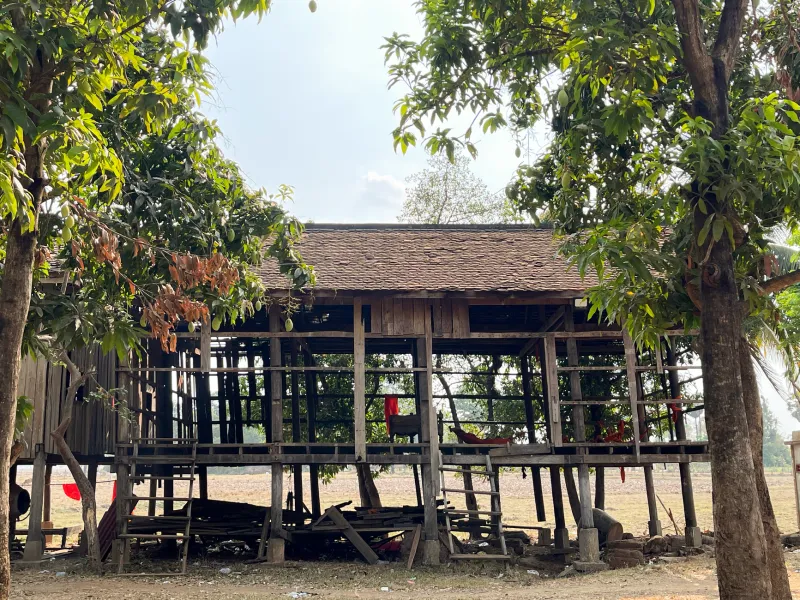
Subterranean termites travel through soil and moisture. Traditional Mekong Delta homes are raised on stilts, piers, or elevated plinths, creating a visible, inspectable gap between ground and structure. Modern Ben Tre construction has adapted this into raised stem walls and elevated slabs on flood-prone sites.
The American parallel is straightforward. In FEMA-designated flood zones across Florida, elevated construction is already required — but elevation is rarely marketed as termite defense. A raised pier foundation with a ventilated crawl space does double duty: it reduces flood exposure and forces termites to build visible mud tubes across an open gap where they can be spotted and interrupted during a routine walk-around.
2. Airflow Is a Structural Material
Humidity is the termite's accomplice. Damp wood is easier to excavate, and moisture is what draws colonies upward in the first place. Ben Tre builders treat ventilation as a structural system: high clerestory openings, vented floor assemblies, and wide eaves that keep walls dry after the afternoon rain.
In Florida terms, a well-ventilated, dehumidified crawl space is not a comfort upgrade — it is a termite deterrent that also reduces mold risk and extends the life of every wooden component in the house. Builders who specify conditioned or heavily ventilated crawl spaces are, in effect, installing a passive pest-control system.
3. Material Choice Does the Silent Work
The Mekong Delta's material tradition leans on naturally durable species and farm byproducts: dense tropical hardwoods where budget allows, treated bamboo in modern applications, fired brick, and cement-based panels for ground-contact elements. Critically, cellulose-rich materials are kept away from soil contact, and vulnerable elements are detailed so they can be replaced cheaply rather than repaired expensively.
US builders have access to an even stronger version of this toolkit: naturally termite-resistant heartwoods, borate-treated lumber, fiber-cement siding, steel framing for ground-level details, and termite shields at sill plates. The Ben Tre lesson is not any single product — it is the discipline of asking, for every material that touches the ground or holds moisture, whether a more durable alternative exists at a reasonable premium.
Running the Numbers
Consider a representative comparison for a 2,000-square-foot home in Central Florida.
The conventional path: slab-on-grade construction, standard framing, a chemical soil treatment at roughly $1,200–$2,000, and annual monitoring at $300–$500 per year. Over a 30-year mortgage, monitoring alone approaches $15,000 — and it does not guarantee a repair-free outcome. The average repair claim for a significant Formosan infestation runs from $8,000 to well over $30,000 when structural members are involved, and insurance typically does not cover it.
The prevention-through-design path: elevated or stem-wall foundation with a ventilated crawl space (often a modest premium over slab in flood-adjacent zones, where elevation may be required anyway), borate treatment of framing at roughly $1,500–$3,000, fiber-cement or termite-resistant cladding at the ground level, and physical termite shields at critical junctions. Upfront cost might run $4,000–$7,000 higher. But borate treatment is a one-time application, the inspectable gap eliminates the surprise factor, and the durable ground-level materials simply do not feed the colony.
Break-even typically arrives within the first decade — faster if a single avoided infestation is counted. And unlike chemical barriers, which degrade and require reapplication, physical and material defenses hold for the life of the structure.
The Broader Lesson: Build for the Climate You Have
What Bến Tre's builders understand, and what the American Gulf Coast is slowly relearning, is that humidity-driven decay and termite pressure are not anomalies to be treated — they are constants to be designed around. A house that stays dry, breathes well, sits above the soil, and uses durable materials at its most vulnerable points is a house that costs less to defend, not more.
None of this requires exotic technology. It requires shifting termite defense from the pest-control invoice to the architectural drawing — where, in the humid tropics, it has always belonged.