Salt Doesn't Lie: A Five-Minute Field Test for Coastal 'Green' Building Materials
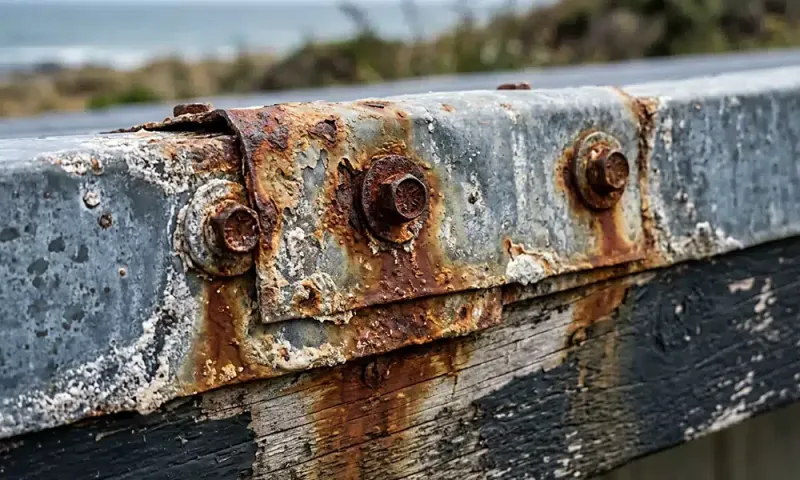
Photo: coastal weathered building material sample salt air corrosion test, via tacticalroofing.co.nz
In Ben Tre, the coconut capital of Vietnam's Mekong Delta, a building material has one of two futures: it endures the salt-laden winds off the East Sea, or it ends up on a scrap pile within a few seasons. There is no mild middle ground. That reality has made local builders ruthless evaluators — and it is exactly the mindset American coastal homeowners need before they pay a premium for anything stamped 'sustainable.'
The problem in the US market is not a shortage of green products. It is a shortage of green products tested against the conditions that actually matter on a coastline: chloride-laden air, wind-driven moisture, and humidity that rarely dips below 80 percent. A bamboo composite rated for a dry inland climate can delaminate in a single Gulf Coast summer. An 'agricultural waste' panel can swell, wick moisture, and feed mold long before its third birthday.
So before you load your cart, run what Ben Tre suppliers informally call the salt test. It takes five minutes, costs nothing, and will disqualify more greenwashed products than any certification logo.
The Five-Point Field Test
1. The sniff test. Pick up the material and smell it. Anything with a sharp chemical or 'gluey' odor is off-gassing volatile compounds — often from binders that will also break down fastest in humid air. Well-processed coconut husk fiber, rice husk board, and mineral-based products should smell faintly earthy or like nothing at all.
2. The edge check. Run your thumb along a cut edge. If fibers fuzz, flake, or the layers visibly separate, moisture has an entry point. Coastal air finds every unsealed edge, and once water gets between layers of a composite, delamination is a matter of when, not if.
3. The weight-to-warmth ratio. Heft the sample. Dense materials that still feel relatively light — properly treated bamboo, compressed husk board — usually indicate tight fiber structure, which resists both water uptake and salt crystallization. Anything unusually heavy for its size may be moisture-saturated already, right there in the store.
4. The finish interrogation. Ask one question of the salesperson: 'What happens to this coating in salt spray?' If the answer is a warranty document rather than a description of the finish chemistry, be cautious. Ben Tre builders favor naturally salt-tolerant finishes — lime plasters, dense tung-oil treatments — over thin film coatings that chip and let chlorines reach the substrate.
5. The fastener look-around. Glance at how the product is designed to attach. If it requires standard steel screws or nails, budget for 316-grade stainless hardware. A genuinely coast-ready material system anticipates this; a greenwashed one ignores it, and the fasteners fail before the panels do.
The Red-Flag List
Our experience with Ben Tre's coastal supply chains suggests certain trendy categories deserve extra skepticism within three years of ocean exposure:
- Untreated 'rapid-renewable' bamboo siding. Bamboo is remarkable when heat- or borate-treated by craftsmen who know the species. Raw strand bamboo marketed as naturally weatherproof is not.
- Lightweight wheat or straw boards in exterior applications. Excellent interior partitions; poor exterior cladding in a marine zone.
- Thin-film 'eco' coatings on bare metal. Powder-coated aluminum is fine; a sprayed low-VOC film over standard steel is a rust clock.
- Recycled plastic lumber with hollow cores. Solid recycled composites perform well near the ocean. Hollow profiles trap condensation and salt.
- Any 'sustainable' product with no published water-absorption or salt-spray rating. If the manufacturer cannot tell you how it behaves in ASTM B117 salt spray or a comparable test, assume the answer is bad.
Why the Delta Perspective Matters
What distinguishes Ben Tre's building tradition is not exotic technology — it is the discipline of assuming the worst the weather will deliver. Coconut husk fiber, the province's signature material, earned its place in construction precisely because generations of builders watched it shrug off salt air that destroyed alternatives. Materials there are selected by survival, not by marketing.
American homeowners shopping for green products rarely get that feedback loop; the sales cycle is faster than the failure cycle. The five-minute field test above compresses decades of coastal trial and error into a single aisle walk. It will not replace a spec sheet or a coastal engineer, but it will stop the most common and most expensive mistake in sustainable building: paying extra for a material that was never asked to survive the view it was sold to face.
The ocean is the most honest materials auditor in the world. Test before it does.