Before the Paint Can: What Ben Tre's Lime-Washed Walls Know About Humidity That Your HVAC Doesn't
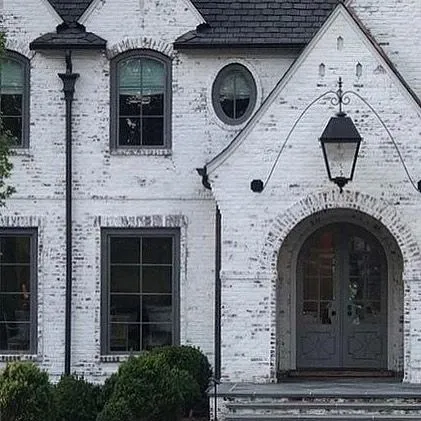
Photo: traditional lime washed wall white chalky finish old house exterior, via i.pinimg.com
A Finish Older Than the Electric Grid
Drive through the older villages of Ben Tre province and you will notice something about the houses that have stood for sixty, seventy, even a hundred years. Their walls carry a soft, chalky luminescence that no acrylic paint can quite imitate. That finish is lime wash — slaked lime, water, and sometimes a handful of local additives — applied in thin coats and renewed every few years by the homeowner.
What looks like simple tradition is actually a sophisticated moisture-management system. In one of the most humid climates on Earth, these walls have been quietly solving the indoor humidity problem that American builders spend billions on with dehumidifiers, sealed vapor barriers, and oversized air conditioners.
The Problem With Sealed Walls
Most modern paint is essentially a plastic film. Acrylic and latex coatings are formulated to shed water, resist staining, and flex with the substrate. They do that well. But they also dramatically slow the passage of water vapor through the wall assembly.
In a humid climate — whether the Mekong Delta or coastal Louisiana, Florida, or the Carolinas — moisture is constantly trying to move. It comes from showers, cooking, wet clothing, and simply from humid air finding its way through imperfect building envelopes. When a wall can't release that vapor, it accumulates. The result is the familiar American catalog of problems: musty closets, mold blooming behind furniture, peeling paint, and rot hidden inside wall cavities.
The standard response has been to seal harder and condition more. But sealing is a strategy with a failure mode: any gap, crack, or penetration becomes a moisture trap. Lime works on the opposite principle.
How Lime Manages Moisture
Lime plaster and lime wash are what building scientists call vapor-open, or hygroscopic, finishes. The calcium carbonate structure is full of microscopic pores that absorb water vapor when indoor humidity rises and release it when the air dries out. In effect, the wall becomes a passive humidity buffer, flattening the peaks and valleys that make rooms feel clammy.
Lime also carries a high alkalinity — around pH 12 when freshly cured — which creates an environment hostile to mold and many of the bacteria that produce the sour smells of a damp house. This is not a marketing claim; it is basic chemistry, and it is one reason lime finishes have been used in granaries, dairies, and hospitals for centuries.
There is a thermal benefit as well. A hygroscopic wall that moderates humidity also moderates perceived temperature. Dry-feeling air at 82°F is more comfortable than clammy air at 78°F, which means occupants can often raise thermostat setpoints — or, in the Ben Tre houses that predate electricity, skip mechanical cooling altogether.
What It Costs
Lime wash is one of the cheapest finishes per square foot available. Bulk hydrated lime is inexpensive, and traditional application — thin coats brushed on, allowed to carbonate over days — requires more labor than materials. Homeowners in Ben Tre routinely refresh their own walls, which is part of the system's economics: the finish is maintainable by the person who owns the house, not just by a contractor.
For American applications, honest budgeting should account for:
- Surface preparation. Lime adheres best to lime, masonry, and mineral substrates. Applying it over sealed acrylic paint requires stripping or a compatible primer, which is where most of the labor cost lives.
- Multiple coats. Expect three to five thin applications rather than one heavy pass.
- Curing time. Lime carbonates slowly. It looks patchy for the first weeks and reaches full durability over a month or more.
- Maintenance. Unlike a 15-year acrylic job, lime wash weathers gracefully but needs refreshing every few years — a two-hour task, not a repainting project.
Compared with a premium paint job, the material cost is comparable or lower; the labor profile is different, front-loaded into preparation rather than repeated replacement.
The American Case
The Southeastern United States shares Ben Tre's fundamental challenge: heat plus moisture. Cities from Houston to Charleston spend enormous sums fighting mold, and the default specification — sealed gypsum board, plastic-based paint, mechanical dehumidification — treats the symptom while creating the conditions for the next failure.
This is not an argument to abandon modern building science. Vapor management must be designed as a whole-wall system, and retrofitting lime over the wrong substrate invites trouble. But for new masonry construction, adobe and rammed-earth projects, historic restorations, and any homeowner battling chronic dampness, the question deserves a place in the specification meeting: what if the wall itself did the humidity work?
Tradition as Technology
At HTX Xanh Bến Tre, we see lime wash as part of a broader lesson the Mekong Delta offers builders everywhere: the greenest solutions are often the ones that predate the machine age, validated by generations of field testing. A finish that breathes, resists mold by chemistry rather than biocides, costs pennies to renew, and makes occupants comfortable with less mechanical cooling is not nostalgia. It is engineering that happens to be very old.
The smartest thermostat on the market reacts to humidity after it enters the room. A lime-washed wall manages it before it gets there. In a warming, wetter world, that difference is worth more than a coat of paint.