Design Like the Monsoon Is Coming: Tropical-Climate Building Lessons That Could Save American Homeowners Billions
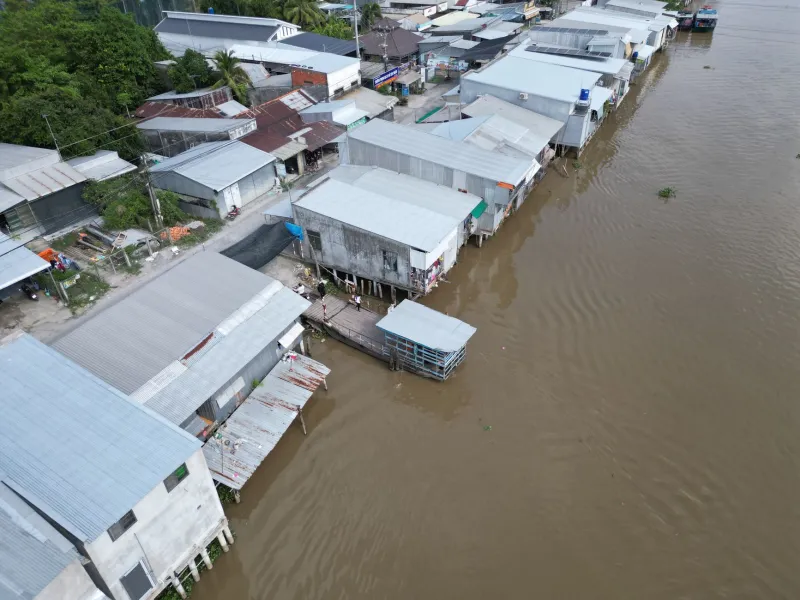
Ask an American homeowner what their house will cost them over thirty years, and most will quote the mortgage. Ask a builder in Ben Tre province the same question, and the answer begins somewhere else entirely: with the termites, the 90 percent humidity, and the typhoon that may arrive in October.
In Vietnam's Mekong Delta, where our cooperative has spent years refining green construction for one of the most punishing climates on Earth, maintenance is not an afterthought. It is the organizing principle of design. And as climate volatility pushes repair costs for US homeowners past $100 billion annually — with water damage, rot, and pest destruction leading the ledger — the Delta's defensive playbook deserves a closer look from American builders.
Why Humidity Changes Everything
The Mekong Delta receives more than 1,500 millimeters of rain annually, with relative humidity that rarely dips below 70 percent. Under those conditions, a wall assembly that traps moisture becomes a biology experiment. Mold colonizes drywall within weeks; framing lumber delaminates; fasteners corrode from the inside out.
Ben Tre builders respond with what might be called breathable construction. Wall systems are designed to dry in at least one direction, favoring vapor-permeable renders, ventilated rain screens, and lime-based plasters over sealed, plastic-wrapped assemblies. The governing insight is simple but frequently violated in American practice: a building that gets wet must also be allowed to get dry.
The humid Gulf Coast and Southeastern United States — from Houston to Mobile to Tampa — face strikingly similar conditions. Yet many American homes in these markets are still built with vapor-barrier strategies imported from drier climates, then wrapped in impermeable siding. The result is the mold litigation boom of the 2000s and the ongoing epidemic of rot behind stucco and EIFS cladding.
Termites Are a Design Problem, Not Just a Pest Problem
The Formosan subterranean termite, now entrenched across the Gulf South, causes an estimated $1 billion in damage each year in the United States alone. In Ben Tre, where Coptotermes species are even more aggressive, builders long ago stopped treating termites as an extermination issue and started treating them as an architectural one.
The local techniques are refreshingly low-tech:
- Elevated and articulated foundations. Raising floor levels above grade — historically on stilts or plinths, today on reinforced ground beams — breaks the concealed soil-to-wood pathway termites prefer and makes inspection visible and easy.
- Termite shields and continuous metal flashings. A simple folded metal barrier at the sill plate forces subterranean colonies to build visible mud tubes, converting a hidden invasion into a detectable one.
- Naturally durable materials. Dense local hardwoods and acetylated or thermally modified timber resist both decay fungi and insect attack without chemical loads, a principle echoed by American research into modified woods for ground-contact use.
None of this eliminates pest management. It reduces the attack surface so dramatically that maintenance becomes a scheduled walkthrough rather than an emergency.
Building for the Storm That Hasn't Hit Yet
Typhoons and tropical depressions sweep the Vietnamese coast with regularity, and Ben Tre's builders have internalized a hierarchy: keep the roof on, keep the water out, let the structure breathe if water gets in anyway.
Roof geometries tend toward hips rather than gables, reducing wind uplift at vulnerable corners. Overhangs are generous, shielding wall openings from wind-driven rain. Openings are proportioned and reinforced with the assumption that shutters will be needed. And critically, interior finishes are chosen for recoverability — materials that can dry or be replaced cheaply — rather than for fragility disguised as luxury.
Compare this with American coastal construction, where the code floor has risen since Hurricane Andrew but where design ambition still too often outruns resilience. The lesson from the Delta is not exotic engineering; it is a philosophy: design for the worst decade, not the best year.
A Checklist for Humid Southern US Markets
For American builders and homeowners ready to borrow from the tropical playbook, we suggest the following adaptation sequence:
- Map your moisture before you design. Use ASHRAE climate zone data and local dew point records to determine which direction your wall assembly must dry — then design it to do so.
- Lift the structure off the wet. Elevated slabs, pier-and-beam foundations, and flood-vent compliance (per FEMA guidance) pay dividends in both termite defense and flood insurance premiums.
- Choose rot-resistant materials at every vulnerable junction. Sills, decks, trim, and ground-contact elements should be modified wood, dense hardwoods, or durable species — not the cheapest treated pine on the yard.
- Ventilate the envelope. Rain-screen gaps behind cladding, ventilated attics or sealed-and-conditioned alternatives, and breathable interior finishes keep assemblies dry after they get wet.
- Detail for wind-driven rain. Hip roofs, deep overhangs, and layered flashings at every opening — treat the next hurricane as a scheduling certainty.
- Budget for inspection, not just construction. A house designed to be inspected is a house that stays cheap to own.
The Economics of Pessimism
There is a persistent myth that resilience is a premium product. Ben Tre's experience argues the opposite: most tropical defensive detailing costs single-digit percentages more at construction and repays itself through avoided repairs within the first cycle of storms or termite seasons. The Delta's builders are not pessimists; they are accountants with long memories.
American housing is entering an era when the Gulf's climate increasingly resembles the Mekong's. The knowledge to build for that reality already exists — it has simply been living in a province better known for its coconut groves than its construction science. Importing it may be the most cost-effective renovation the American South never knew it needed.